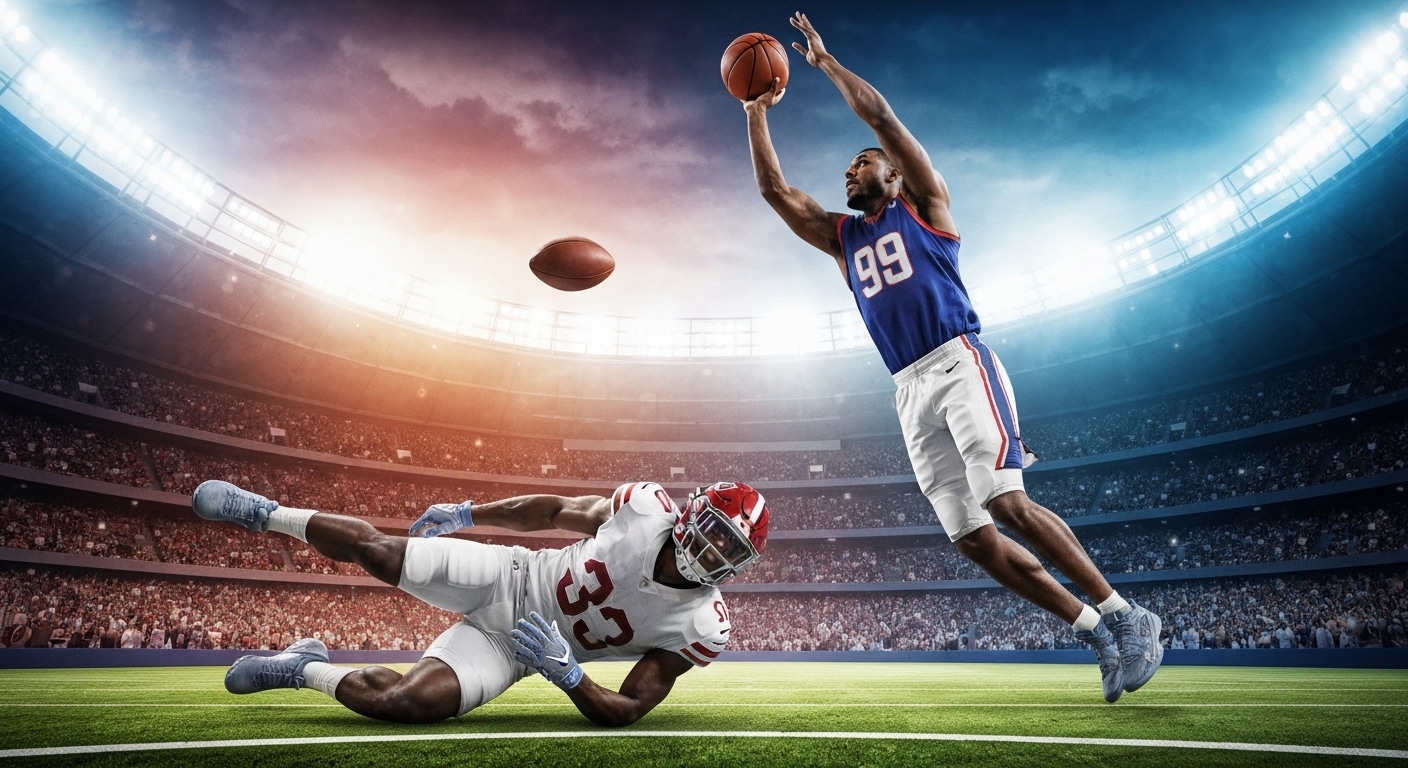
Why NFL vs NBA Softness Debate Dominates Sports Talk 2026
It happened again last week. In the dying seconds of the NFC Championship, a game-sealing interception was wiped out by a questionable roughing-the-passer flag. Two nights later, an NBA superstar drew a flagrant foul for what many viewers saw as a minor shove. Instantly, your phone buzzed, the sports channels lit up, and the internet erupted with a familiar, fiery argument. This is the background noise of modern sports fandom, and it’s why the NFL vs NBA softness debate dominates sports talk in 2026.
This argument is more than just a time-filler between games; it’s a permanent fixture on talk shows, podcasts, and social media. But arguing over which league is “softer” misses the bigger picture. This article doesn’t seek to crown a winner. Instead, we’ll explore the complex reasons why this debate has become one of the most enduring and passionate conversations in sports. We’ll dive into evolving rules, the powerful influence of media, the psychology of the modern fan, and what the data actually tells us about physicality in today’s game.
A Tale of Two Evolutions: How Rule Changes Built the Modern Battlefield
To understand why we argue about this in 2026, we have to look at how we got here. The NFL and NBA didn’t arrive at their current states by accident; they followed two very different evolutionary paths, each fundamentally altering the definition of “toughness” within their sport.
The NFL’s journey has been defined by a reactive, and necessary, focus on player safety. The growing awareness of the long-term effects of concussions and CTE in the late 2000s and 2010s forced the league’s hand. The result was a wave of rule changes designed to protect players, particularly “defenseless” receivers and, most importantly, quarterbacks. Rules like the one penalizing defenders for landing on a QB with their full body weight, or the expansion of illegal contact downfield, were implemented to prolong careers and mitigate devastating injuries. While laudable in intent, these changes created a visual disconnect for fans accustomed to the bone-jarring hits of the 70s, 80s, and 90s. Every flag for “roughing the passer” became a referendum on the league’s soul.
Meanwhile, the NBA embarked on a proactive quest for a different kind of perfection: a fluid, fast-paced, and high-scoring product. Starting in the early 2000s, the league systematically eliminated the physical impediments that defined the gritty “Bad Boy” Pistons and Pat Riley’s Knicks. The removal of the illegal defense rule opened up the court, and the strict enforcement of hand-checking and freedom of movement gave offensive players an unprecedented advantage. The goal was to showcase athleticism and skill, leading to the offensive explosion we see today. For fans who grew up watching Michael Jordan fight through the “Jordan Rules,” the modern game, with its emphasis on floor spacing and foul-drawing, can appear less physically demanding.
These two paths created the perfect storm. One league legislated out its most visceral violence for safety, while the other legislated out its most grinding physicality for aesthetics. The result? Two wildly successful, athletically incredible products that look fundamentally different from their own past, providing endless fuel for the “softness” debate.
The Voices in the Arena: What Players and Coaches Really Think
While fans and media argue from the sidelines, the people on the court and the field have a uniquely nuanced perspective. Their views often cut through the noise, revealing a more complex picture of modern game physicality.
Many retired players, especially those from pre-2010 eras, are the most vocal critics. A former All-Pro NFL linebacker might say, “We knew what we signed up for. My job was to impose my will on the quarterback. Today, you have to pull up or you’re paying a fine and costing your team 15 yards. It’s a different game.” Similarly, a retired NBA enforcer from the '90s could lament, “We were allowed to be physical. You could put a forearm on a guy, let him know you were there. Now, you breathe on a guy and it’s a foul. The skill is incredible, but the physical intimidation is gone.”
Current players, however, offer a sharp rebuttal. A modern NBA All-Star might explain, “People see a foul and call it soft, but they don’t see the non-stop movement. We’re covering more ground, faster than ever. The toughness isn’t about throwing an elbow; it’s about being able to play at that athletic peak for 40 minutes a night, four times a week.” A top-tier NFL wide receiver would echo this sentiment. “The game is safer, and that’s a good thing. But don’t mistake that for ‘soft.’ You’re still running full speed into elite athletes who are bigger, stronger, and faster than ever before. The collisions are still violent, they’re just legislated differently.”
Coaches are caught in the middle, tasked with winning within the new frameworks. An NFL head coach has to drill his pass rushers to sack the quarterback while contorting their bodies to avoid a penalty—a new form of athletic discipline. An NBA coach designs entire offensive schemes around exploiting the freedom-of-movement rules. Their job isn’t to pine for a bygone era but to master the realities of the modern game, a testament to how deeply these evolutionary changes are embedded.
The Great Amplifier: How Media Fuels the Fire 24/7
The “softness” debate wouldn’t dominate our conversations without a powerful engine amplifying it around the clock: the modern sports media landscape. This topic is, to put it bluntly, a content goldmine.
Daily sports talk shows, from television to radio, are built on binary, argumentative frameworks. The question “Which league is softer?” is the perfect topic. It requires no deep statistical analysis, it pits two massive fanbases against each other, and there is no “right” answer, meaning the debate can be reset and re-litigated every single day. It allows hosts to take theatrical, entrenched positions, creating the on-air conflict that drives ratings and social media clips.
The digital media ecosystem thrives on this even more. A controversial foul call in an NBA game or a questionable flag in an NFL game is instantly clipped and blasted across X, Instagram, and TikTok. The algorithms on these platforms are designed to promote engagement, and nothing generates more furious comments, shares, and arguments than a post with the caption, “Is the NFL getting too soft?” or “You could never do this in the '90s NBA.” As seen in countless online discussions, like a recent podcast episode from ‘Speak Up Now’, creators are constantly tapping into this debate because it guarantees a reaction.
Furthermore, it’s a cross-sport comparison that allows media personalities to showcase their breadth of knowledge. It’s a way to engage both NFL and NBA fans simultaneously, maximizing audience reach. The media doesn’t just report on the debate; it has a vested financial and strategic interest in keeping the fire stoked. It’s a self-sustaining content loop, and as long as it generates clicks, views, and callers, it will remain a central pillar of sports talk.
The Fan Factor: Nostalgia, Identity, and Generational Divides
Beyond the rules and the media, the reason this debate resonates so deeply is because it taps into powerful psychological drivers within the fan. For many, this isn’t just an argument about sports; it’s about identity, memory, and a changing world.
Nostalgia is arguably the most potent force at play. Fans who grew up watching Lawrence Taylor terrorize quarterbacks or Charles Oakley patrol the paint in Madison Square Garden remember that era as the sport’s zenith. That period of their lives is intertwined with a specific brand of physicality. When they watch the modern game, they aren’t just seeing different rules; they’re seeing a challenge to their cherished memories and a sign that the world they knew has changed. The “softness” label is often a shorthand for “it’s not like it was when I fell in love with the game.”
Our favorite sports also become part of our identity. A die-hard football fan sees their sport as a modern-day gladiatorial contest, a test of ultimate toughness and sacrifice. An avid basketball fan sees their sport as a showcase of supreme, world-class athleticism and skill. An attack on a league’s “toughness” can feel like a personal attack on the fan’s own judgment and values. Defending their sport’s honor becomes a defense of themselves.
Finally, there’s a clear generational divide. Older fans, who may have valued brute force and a higher tolerance for on-field violence, are more likely to view the current landscape as soft. Younger fans, who grew up with today’s superstars and have a greater awareness of player health and long-term safety, are more likely to define toughness in terms of athletic skill, endurance, and resilience. This isn’t just an NFL vs. NBA debate; it’s a proxy war for a larger cultural conversation about what we value in our athletes and our entertainment.
Beyond the Hot Takes: What Does the Data Say About Physicality?
In a debate fueled by emotion and opinion, it’s easy to lose sight of objective reality. While we can’t definitively measure “softness,” we can use data to better understand the different physical demands of each sport. Comparing the two isn’t about apples and oranges; it’s about comparing two completely different types of physical stress.
The physicality of the NFL is about acute, high-impact force. Think of it in terms of physics: force equals mass times acceleration. An offensive lineman weighing 320 pounds colliding with a defensive lineman of similar size creates a catastrophic impact, even on a routine play. The game consists of short, explosive bursts of energy followed by periods of rest. The toughness required is the ability to absorb and deliver these violent, full-body collisions play after play and to get up and do it again.
The physicality of the NBA is about chronic, sustained load and explosive agility. Player tracking data reveals that an elite NBA player can run several miles in a single game, all while constantly jumping, landing, and changing direction at high speeds. The toughness here is cardiovascular and kinetic. It’s the durability to withstand the relentless wear and tear on joints—ankles, knees, and backs—from a grueling 82-game season. It’s the core strength to absorb contact while airborne and the stamina to perform at an elite level in the final minutes of a game.
So, which is “harder”? It’s an unanswerable question. Is it tougher to endure a handful of car-crash-level impacts in a three-hour NFL game or to withstand the constant, grinding physical stress of a 48-minute NBA game? The data doesn’t point to one being “softer,” but rather confirms they are two distinct and extreme athletic challenges.
Conclusion: The Debate Isn’t Going Away, and That’s the Point
So, why does the NFL vs. NBA softness debate dominate sports talk in 2026? Because it was never about finding a real answer. The debate’s persistence is the result of a perfect storm: two leagues on divergent evolutionary paths, a 24/7 media machine that profits from conflict, and the deep-seated psychology of fan identity and nostalgia. It’s a conversation that reflects our changing values regarding player safety, entertainment, and the very definition of athletic greatness.
The argument isn’t a bug in the system; it’s a feature of the modern sports landscape. It’s a permanent, self-sustaining part of how we talk about the games we love. It will rage on next week, next month, and next season, evolving with every new rule change and every new generation of fans and athletes. Ultimately, its dominance proves that the passion for these sports is as strong as ever.
What do you think is the biggest reason this debate never ends? Share your perspective in the comments below.
Frequently Asked Questions
What are the main arguments suggesting one league has become ‘softer’ than the other?
The debate often centers on rule changes implemented for player safety or to increase offensive flow. Critics of the NBA point to reduced defensive contact and higher scoring, while NFL safety protocols, though crucial, are sometimes perceived as diminishing the game’s traditional ‘toughness.’ These changes spark discussions about the evolving nature of physicality in both sports.
How do the physical demands of the NBA Playoffs compare to the NFL season, and does this factor into the ‘softness’ debate?
The NBA Playoffs involve a grueling schedule of best-of-seven series, demanding sustained high-level performance over weeks, which some argue is a unique physical and mental grind. Conversely, the NFL season features fewer games, but each is intensely violent with a higher risk of severe injury, presenting a different kind of physical toll. This comparison often fuels arguments about which sport demands more overall ‘toughness’ and endurance.
Why does the NFL vs. NBA ‘softness’ debate continue to dominate sports talk in 2026?
This debate persists due to a confluence of evolving league rules, pervasive media amplification, and fan nostalgia for past eras of sports. It taps into fundamental questions about athletic prowess, player safety, and the changing nature of professional sports, making it a perennial and engaging hot topic.
How does media, including social media, contribute to the ongoing NFL vs. NBA ‘softness’ debate?
Media platforms, from traditional sports shows to social media, act as powerful amplifiers, providing constant outlets for hot takes, player interviews, and fan discussions. This continuous cycle of content and engagement ensures the debate remains front-of-mind, often prioritizing controversy and strong opinions to drive viewership and interaction.
What role do rule changes play in fueling the perception of ‘softness’ in both the NFL and NBA?
Rule changes, often implemented for player safety or to enhance offensive play, are frequently cited as primary reasons for perceived ‘softness.’ In the NFL, stricter concussion protocols and penalties for certain hits alter the game’s traditional physicality, while in the NBA, reduced defensive contact and emphasis on scoring can lead to similar perceptions among fans and analysts.