
Google is making a bold move in travel tech: it’s speeding up the integration of generative AI into its travel tools. The company announced a global rollout of its AI-powered Flight Deals tool, plus a set of fresh planning and booking features in Google Search. This update is a major enhancement for how people find and organize trips — not just finding cheap flights, but building full itineraries with hotels, restaurants, and more.
Here’s a breakdown of what’s new, how it works, and why it matters for travelers.
What Is Google’s AI “Flight Deals” Tool?
-
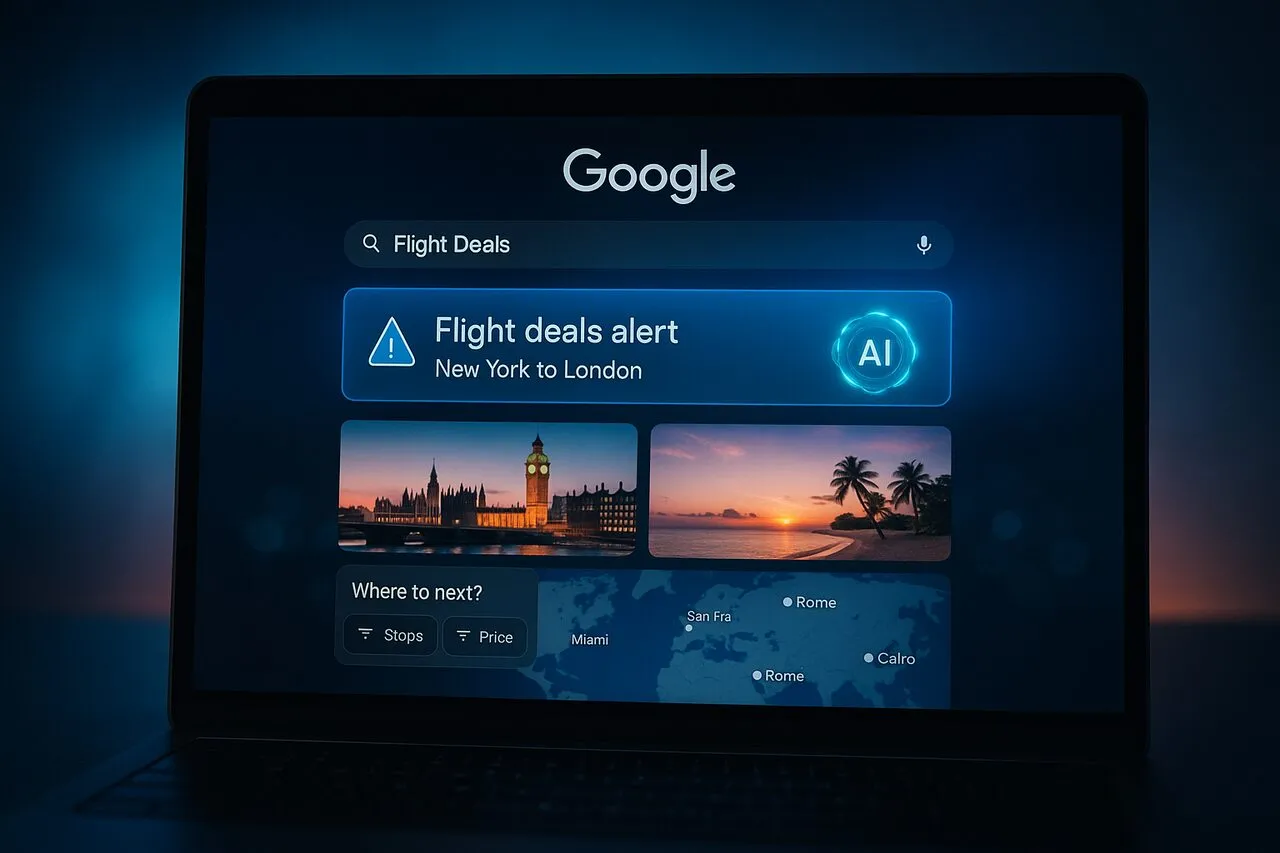
Flight Deals is an AI-driven feature inside Google Flights that helps users discover airfare bargains in a more intuitive way.
-
Rather than manually setting dates and airports, travelers can describe their trip in natural language — for example: “a week-long trip next February to a warm city with great food, nonstop flights only.”
-
The AI uses real-time pricing data from Google Flights, then matches that with your preferences to surface travel deals.
-
In its initial phase, Google launched the tool in just a few markets, but now it’s expanding to over 200 countries and territories.
-
It also supports 60+ languages, allowing more global users to take advantage of deal discovery.
New Planning Features with Google Search & AI Mode
Beyond flight deals, Google is pushing deeper AI-powered planning tools within its Search product:
Canvas: AI-Powered Trip Planning
-
Google’s Canvas feature (in AI Mode) allows users to build travel plans in a side-panel, mixing real-time data from search, Google Maps, and more.
-
You tell AI Mode what type of trip you’re imagining — dates, travel style, must-see attractions — then hit “Create with Canvas.” The system pulls together flight options, hotels, reviews, photos, and more into a draft itinerary.
-
After the AI generates a plan, users can refine it by asking follow-up questions. For instance, you might change your hotel preference or adjust activities based on location or price.
-
The plan stays accessible in your AI Mode history, so you can revisit, tweak, or update it later.
-
Currently, travel planning with Canvas is rolling out on desktop for U.S. users who have opted into AI Mode via Google Labs.
Agentic Booking: AI Makes Reservations Easier
-
Google’s AI Mode is expanding its “agentic” abilities. This means the assistant can now help with restaurant reservations, event tickets, and more.
-
The way it works: you describe what you want (party size, date, cuisine, location), and AI Mode reaches out to various partner platforms to find real-time availability.
-
In the near future, Google plans to allow direct bookings for flights and hotels through AI Mode — enabling a seamless journey from deal discovery to reservation.

Why This Matters: The Impact on Travel
For Travelers: Easier, Smarter Planning
-
This new flight tool meets travelers where they often are — in search — letting them type what they want, not filling out complicated filters.
-
It’s ideal for flexible travelers who don’t have fixed dates or destinations. Instead of manually scanning through options, AI surfaces deals based on your rough plans.
-
The Canvas planning feature combines multiple data sources (maps, reviews, flights, hotels) into one cohesive experience — cutting down the mental load of trip planning.
-
Agentic booking brings convenience: no need to juggle multiple booking sites, AI Mode helps you find and compare options for restaurants, events, and, potentially, flights and stays — all in one tool.
For Google: Strategic Strengthening
-
By embedding AI into travel planning, Google is reinforcing its dominance in search and in travel discovery.
-
With the global rollout, Google may draw more traffic into Google Flights, increasing user engagement and possibly its role as a travel meta-engine.
-
The integration helps Google build a more compelling, AI-first travel service — mimicking some of what travel agents or meta-search engines used to do, but in a much more automated and conversational way.
-
As users increasingly trust AI planning, Google could unlock new partnerships and monetization paths in the travel space.
Challenges & Considerations
-
Accuracy & Price Fluctuations: Airfare changes constantly. Even with AI, some deals may shift in price shortly after you see them.
-
Language & Regional Availability: While over 60 languages are supported, there may still be regions where the AI experience is limited or slower to roll out.
-
Privacy & User Data: Using AI Mode for travel planning means giving Google more insight into your travel habits and preferences — something users should weigh.
-
Beta Features: Some features (like agentic flight/hotel booking) are not yet fully available. The rollout may take time, and some users may not immediately access every function.
-
Competition & Regulation: As Google expands into AI travel, there may be regulatory scrutiny or competition pushback, especially in markets sensitive to its dominance.
How to Try the New Features Yourself
-
Opt into AI Mode in Google Search (if available) or Google Labs.
-
Use the desktop version (currently required for Canvas travel planning).
-
Describe your trip in natural language: e.g., “10-day culture trip to Europe in September under $2000.”
-
Hit “Create with Canvas” to generate a travel plan.
-
Ask follow-up questions to tweak your itinerary — swap hotels, change dates, or refine activity suggestions.
-
Use Flight Deals by typing your travel preferences in Google Flights — AI will show relevant fare options.
-
Experiment with agentic booking for restaurants and events (currently expanding), and watch for flight/hotel booking to be added later.
Why This Could Be a Game-Changer for Travel
-
It lowers the barrier for people who find travel planning overwhelming.
-
It gives flexible travelers a powerful tool to find deals they might not discover otherwise.
-
It positions Google not just as a search company, but as a travel assistant capable of handling planning, booking, and discovery in one place.
-
As more travelers trust AI for trip planning, Google could become a central hub for travel decisions — away from traditional metasearch sites.
Google’s global rollout of its AI-powered Flight Deals tool, together with Canvas planning and expanded agentic booking, signals a major shift in how travel planning works. Rather than toggling through multiple sites or manually comparing flights, Google is offering a more conversational, intelligent, and integrated way to plan a trip — from inspiration to reservation.
For travelers, this means more freedom, better deals, and less friction. For Google, it’s a strategic play: embedding AI deeply into search and travel to deliver value and lock in engagement. While some features are still coming, the direction is clear — AI is becoming not just a helper, but a co-pilot for your next trip.