
Meta Cuts Hundreds of Jobs as AI Spending Surges in 2026
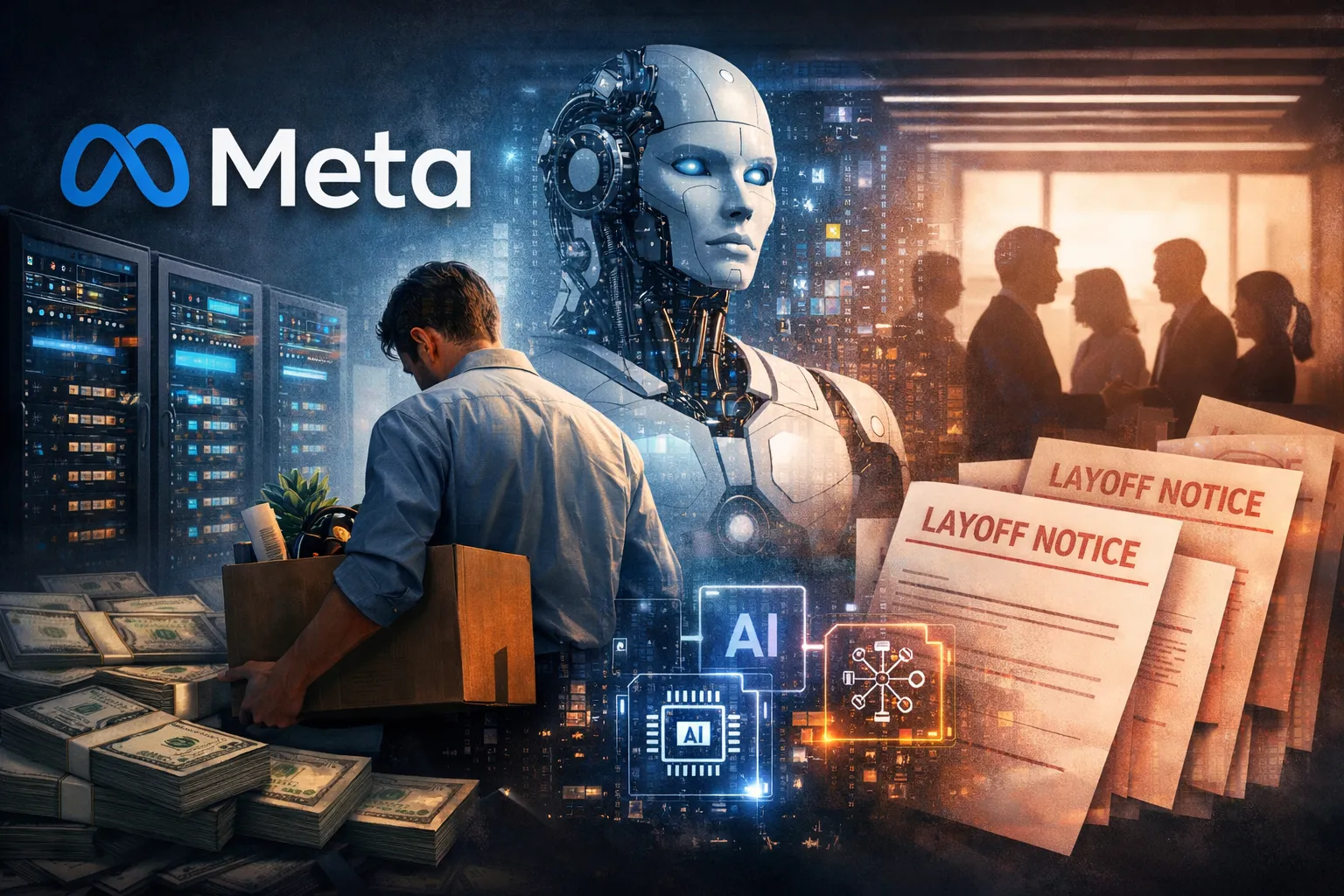
In yet another sign of how rapidly the tech industry is evolving, Meta Platforms has confirmed it is cutting several hundred jobs across multiple teams. The move comes as the company doubles down on artificial intelligence (AI), pouring billions into infrastructure, talent, and long-term innovation.
While the layoffs represent a relatively small percentage of Meta’s total workforce, they highlight a deeper transformation happening not just within the company—but across Silicon Valley as a whole.
A New Round of Layoffs Hits Meta
Meta’s latest round of job cuts will impact employees across departments including sales, recruiting, and its high-profile Reality Labs division. According to reports, fewer than 1,000 employees are affected, out of a workforce that stood at nearly 79,000 at the end of 2025.
The company framed the layoffs as part of routine restructuring rather than a large-scale downsizing initiative.
In a statement, a Meta spokesperson emphasized that internal changes are necessary to keep teams aligned with company goals. Some affected employees may be offered alternative roles or relocation opportunities within the organization.
Still, for workers and industry observers, the message is clear: even the biggest tech giants are not immune to workforce reshaping in the age of AI.
Why Meta Is Cutting Jobs Now
At the heart of Meta’s decision lies one key factor—its aggressive push into artificial intelligence.
The company has announced plans to spend between $115 billion and $135 billion on capital expenditures in 2026 alone, much of it tied directly to AI infrastructure and development.
This includes:
- Building massive data centers
- Developing proprietary AI chips
- Hiring specialized AI engineers
- Expanding machine learning capabilities across products
Such enormous spending requires trade-offs. And increasingly, those trade-offs are showing up in the form of workforce reductions.
Industry analysts note that Meta is not simply cutting costs—it is reallocating resources. Jobs tied to legacy functions or slower-growth areas are being eliminated, while new roles tied to AI are expanding rapidly.
Reality Labs Continues to Feel the Pressure
One of the most impacted divisions is Reality Labs, Meta’s unit responsible for virtual reality (VR), augmented reality (AR), and metaverse-related projects.
Earlier in 2026, Meta had already cut roughly 10% of Reality Labs staff—about 1,000 employees—before this latest round of layoffs.
Reality Labs has long been a major investment area for Meta, but it has also been a significant financial drain, generating billions in losses annually.
Now, the company appears to be shifting focus away from the metaverse hype that once defined its strategy, and toward AI-driven products that promise more immediate returns.
This pivot reflects a broader industry trend: while immersive virtual worlds remain a long-term vision, AI is delivering real-world applications—and revenue—today.
The Bigger Picture: AI Is Reshaping Big Tech
Meta’s layoffs are not happening in isolation. Across the tech industry, companies are restructuring to prioritize AI.
From cloud computing to automation, AI is rapidly changing how businesses operate—and how many people they need.
Reports suggest that tens of thousands of tech jobs have already been eliminated in 2026, with AI cited as a contributing factor in many cases.
Other major companies, including Amazon and Microsoft, have also adjusted their workforce strategies in response to rising AI costs and shifting priorities.
In this environment, companies are seeking:
- Leaner teams
- Higher productivity per employee
- Greater reliance on automation
The result is a paradox: while AI creates new opportunities, it also reduces the need for certain roles.

Meta’s Strategy: Efficiency Over Expansion
CEO Mark Zuckerberg has spent the past few years transforming Meta into what he calls a “more efficient company.”
After years of rapid hiring during the pandemic-era tech boom, Meta is now focusing on:
- Flattening organizational structures
- Reducing redundant roles
- Streamlining decision-making processes
This philosophy has already led to multiple rounds of layoffs since 2022, including cuts affecting tens of thousands of employees.
The 2026 layoffs, while smaller in scale, are part of this ongoing effort to reshape the company for long-term sustainability.
What Happens to Affected Employees
For those impacted, Meta says it is attempting to provide support through internal job placements and relocation options where possible.
However, not all employees will be able to transition into new roles.
The broader job market may offer opportunities, especially for workers with technical skills. AI-related expertise is in particularly high demand, and many former Meta employees could find positions in startups or competing tech firms.
Still, the emotional and financial toll of layoffs cannot be overlooked—especially in an industry once known for its stability and high compensation.
Investor Pressure and Rising Costs
Another driving force behind Meta’s layoffs is investor pressure.
With AI spending skyrocketing, shareholders are closely watching how efficiently companies deploy capital.
Meta’s projected expenditures for 2026 are among the highest in the tech industry, reflecting its ambition to lead in AI innovation.
At the same time, investors expect:
- Strong revenue growth
- Improved profit margins
- Clear returns on AI investments
Layoffs, in this context, are often seen as a way to balance the books while funding future growth.
A Shift Away From the Metaverse?
Meta’s rebranding in 2021 signaled a bold bet on the metaverse. But in 2026, the company’s priorities appear to be shifting.
While the metaverse is not being abandoned, it is no longer the sole focus of Meta’s strategy.
Instead, AI is taking center stage.
This includes:
- AI-powered assistants
- Content recommendation algorithms
- Advertising optimization tools
- Enterprise AI solutions
The shift reflects changing market realities. AI is delivering immediate business value, while the metaverse remains a longer-term vision with uncertain returns.
How Employees and Industry Leaders Are Reacting
Reactions to the layoffs have been mixed.
Some industry experts see the move as necessary and even inevitable, given the scale of Meta’s AI ambitions.
Others worry about the broader implications for workers.
Critics argue that:
- Companies may be overestimating AI’s ability to replace human roles
- Frequent layoffs can damage morale and company culture
- Long-term innovation may suffer if experienced employees leave
Meanwhile, supporters believe that restructuring is essential for staying competitive in a rapidly evolving landscape.

What This Means for the Future of Work
Meta’s layoffs are part of a larger story about the future of work.
As AI becomes more powerful, companies are rethinking how they structure teams and allocate resources.
Key trends emerging include:
1. Automation of Routine Tasks
AI is increasingly handling repetitive and administrative work, reducing the need for certain roles.
2. Demand for Specialized Skills
Workers with expertise in AI, data science, and engineering are more valuable than ever.
3. Continuous Reskilling
Employees must adapt to changing technologies to remain competitive in the job market.
4. Leaner Organizations
Companies are aiming to do more with fewer people, relying on technology to boost productivity.
Conclusion: A Turning Point for Meta and Big Tech
Meta’s decision to cut several hundred jobs is more than just another round of layoffs—it’s a reflection of a fundamental shift in the tech industry.
As the company invests heavily in AI, it is reshaping its workforce to align with a new vision of the future.
For employees, this means navigating uncertainty and adapting to new demands.
For the industry, it signals a transition toward a more AI-driven era—one where innovation and efficiency go hand in hand.
And for Meta, it marks yet another step in its evolution from a social media giant into a technology powerhouse focused on the next generation of computing.
The question now is whether this strategy will pay off—and what it will mean for the millions of workers watching from the sidelines.