
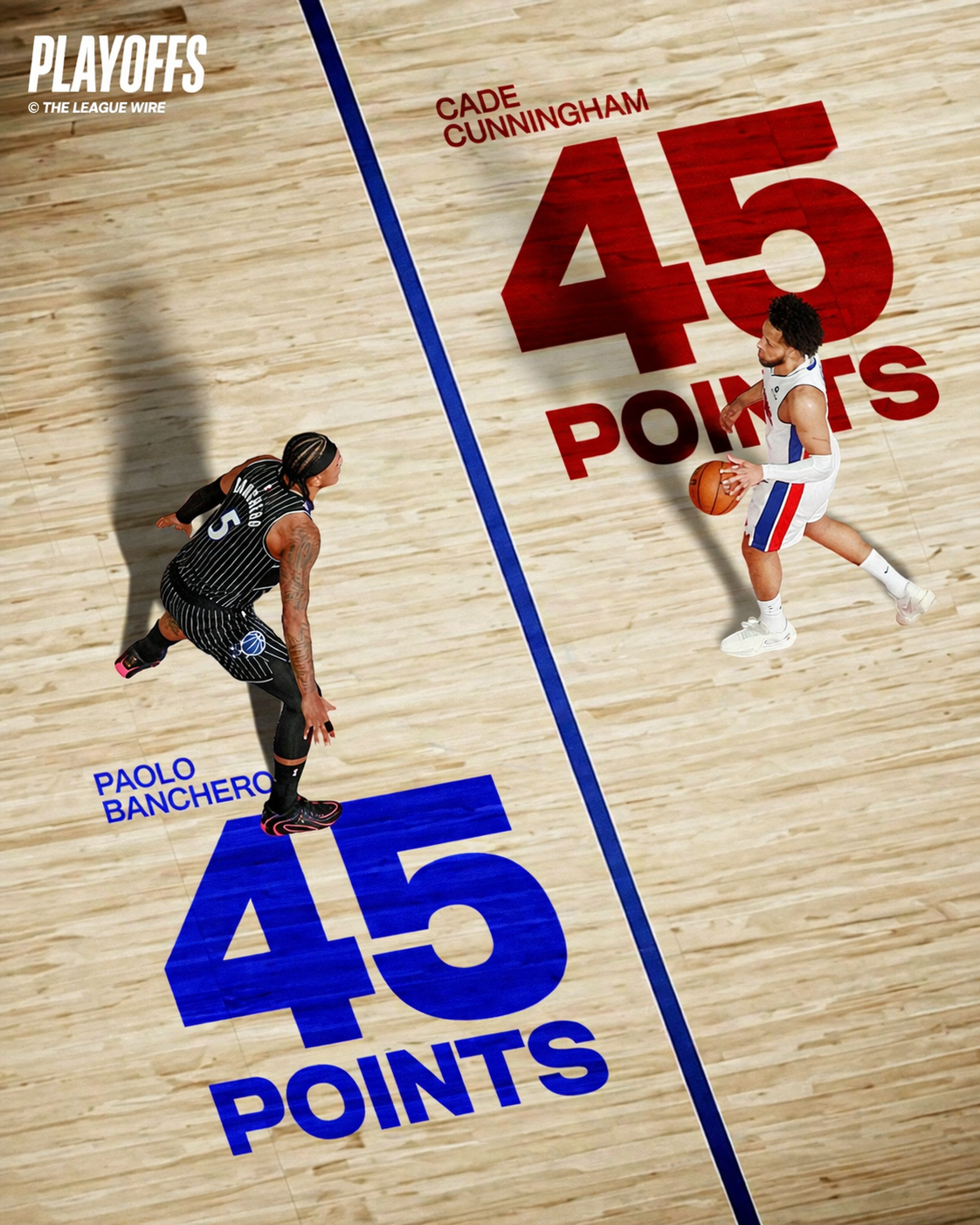
What happened in the Paolo Banchero and Cade Cunningham Game 5 matchup? Paolo Banchero and Cade Cunningham 45 points Game 5 performances resulted in a historic offensive duel where the Orlando Magic defeated the Detroit Pistons to take a 3-2 series lead.
This game marks the first time in over three decades that two opposing players under the age of 23 each scored 45 or more points in a single NBA playoff game.
Key Game 5 Takeaways:
Final Score: Orlando Magic 118, Detroit Pistons 112
Paolo Banchero: 45 PTS, 10 REB, 5 AST (15/26 FG, 12/14 FT)
Cade Cunningham: 45 PTS, 8 AST, 6 REB (17/29 FG, 6/11 3PT)
Series Status: Orlando leads 3-2
Critical Stat: Orlando won the "Points in the Paint" battle 56-42.
How did Paolo Banchero and Cade Cunningham both score 45 points in Game 5?
The scoring explosion was driven by extreme Usage Rates and a lack of secondary defensive help. Both coaching staffs prioritized "ISO-heavy" sets, allowing their stars to dictate the tempo. Banchero and Cunningham combined for 90 points on 55 field goal attempts, representing nearly 52% of their teams' total shot volume.
This result occurred because both teams utilized "drop coverage" in the pick-and-roll for the majority of the first three quarters. By dropping the big man back to protect the rim, Detroit allowed Cunningham to walk into comfortable mid-range jumpers.
Simultaneously, Orlando’s defensive scheme focused on limiting Detroit’s shooters, which left Banchero in one-on-one "island" situations against smaller defenders who could not contain his 250-pound frame.
How did Banchero’s scoring style differ from Cunningham’s?
Why was Paolo Banchero’s interior gravity so effective?
Banchero focused on rim pressure and foul-drawing to reach his 45 points. He attacked the basket 18 times, forcing Detroit’s primary rim protectors into early foul trouble. By the mid-point of the third quarter, Detroit’s starting center had four fouls, which limited the Pistons' ability to contest Banchero's drives without fouling.
Fact: Banchero shot 14 free throws, making 12.
Explanation: He used his "bully-ball" frame to initiate contact in the restricted area, negating Detroit’s verticality.
Impact: This forced Detroit to rotate help defenders off the corners, which eventually opened up three-point opportunities for Orlando’s supporting cast in the fourth quarter.
How did Cade Cunningham navigate Orlando’s perimeter defense?
Cunningham relied on shot creation and three-point efficiency. Unlike Banchero, who lived at the line, Cunningham manipulated screens to find space on the perimeter. He hit six three-pointers, many of which were "off-the-dribble" shots that Orlando’s defenders could not contest due to Cunningham’s 6'6" height and high release point.
Fact: Cunningham recorded an Effective Field Goal Percentage (eFG%) of 68.9% for the game.
Explanation: He exploited "undersized" switches, repeatedly targeting Orlando’s backup guards in the high post.
Impact: This scoring kept Detroit within two possessions despite a significant disadvantage in free-throw attempts and rebounding.
What tactical adjustments defined the Game 5 result?
How did the Magic use "Inverted Pick-and-Rolls"?
Orlando’s team strategy involved using Banchero as the primary ball-handler in "inverted" pick-and-rolls. In these sets, a smaller guard like Jalen Suggs would set the screen for Banchero.
The Tactic: This forced Detroit to either "switch" a smaller defender onto Banchero or "hedge," which left the guard open for a pop-out three.
The Result: Detroit chose to switch, leaving Cunningham or Ivey to defend Banchero in the post. Banchero exploited these mismatches for easy layups or kick-out passes.
Why did Detroit’s defensive rotations fail in the clutch?
In the final five minutes, Detroit attempted to "double-team" Banchero to get the ball out of his hands. However, Orlando responded by placing Banchero at the "nail" (the center of the free-throw line).
The Tactic: From the nail, Banchero could see the entire floor. When the double-team came from the baseline, he quickly found open teammates.
The Result: While Banchero’s scoring slowed in the final two minutes, his playmaking led to two critical corner threes that sealed the game for Orlando.
What do the advanced NBA stats tell us about this performance?
To understand the magnitude of this game, we must look at NBA stats beyond the raw point totals. Both players operated with a Usage Rate (USG%) exceeding 35%, which is typically reserved for MVP-level regular-season performances.
Metric
Paolo Banchero
Cade Cunningham
Points
45
45
True Shooting % (TS%)
69.2%
66.4%
Usage Rate (USG%)
38.4%
37.1%
Offensive Rating (ORtg)
128
124
AST%
22.1%
34.5%
The True Shooting Percentage is particularly notable. For two players to score 45 points while maintaining a TS% near 70% in a high-stakes Game 5 is statistically rare. It indicates that these were not "volume-based" outbursts but rather displays of elite efficiency.
Which team has the advantage heading into Game 6?
What are Orlando’s current strengths and weaknesses?
Orlando’s primary strength is their frontcourt depth and physical style of play. They controlled the boards 48-36, which provided them with a +10 advantage in second-chance points.
Weakness to watch: The Magic remain overly reliant on Banchero for half-court creation. If Detroit successfully traps Banchero in Game 6, Orlando’s "non-Banchero" lineups must prove they can score.
What must Detroit fix to avoid elimination?
Detroit’s bench contribution was non-existent in Game 5. The Pistons' reserves were outscored by 18 points, forcing Cunningham to play 45 minutes.
The Adjustment: Coach Monty Williams must find a way to steal 4-6 minutes of rest for Cunningham without the lead evaporating. This may require moving Jaden Ivey into a more prominent playmaking role when Cunningham sits.
What are the playoff standings and series implications?
The Magic now lead the series 3-2. In NBA history, the winner of Game 5 in a 2-2 series wins the series 82.4% of the time. This victory has shifted the playoff standings momentum heavily toward Orlando.
Upcoming Schedule:
Game 6: Detroit (Home) - Friday
Game 7 (If necessary): Orlando (Home) - Sunday
If Orlando wins Game 6, they will face the winner of the Celtics/Heat series. The high-usage nature of Game 5 suggests that fatigue management will be the deciding factor in the next 48 hours. Both Banchero and Cunningham showed signs of exhaustion in the final 60 seconds of Game 5, missing three combined free throws.
What is the deeper takeaway from the Banchero-Cunningham duel?
This game reveals that the "post-LeBron/Curry" era of the NBA is already here. The player performance of these two young stars proves that the league's talent floor has risen. We are seeing 21 and 22-year-olds carry the offensive load of entire franchises in the most pressurized moments of the season.
Fans should pay attention to how Detroit adjusts their "point-of-attack" defense in Game 6. If they continue to allow Banchero to hunt mismatches through inverted screens, the series will likely end in Detroit. However, if Cunningham receives even a modicum of scoring help from his supporting cast, a Game 7 is almost a certainty.
What to watch for in Game 6:
Double-teaming Banchero: Will Detroit force other Magic players to beat them?
Cunningham’s 3PT Volume: Will he increase his attempts if Orlando packs the paint?
The "Third Star": Which role player (e.g., Franz Wagner or Jaden Ivey) will step up to alleviate the pressure on the 45-point scorers?
This Game 5 wasn't just a statistical outlier; it was a blueprint for the future of the Eastern Conference. Paolo Banchero and Cade Cunningham 45 points Game 5 will be remembered as the night two future legends officially arrived on the playoff stage.