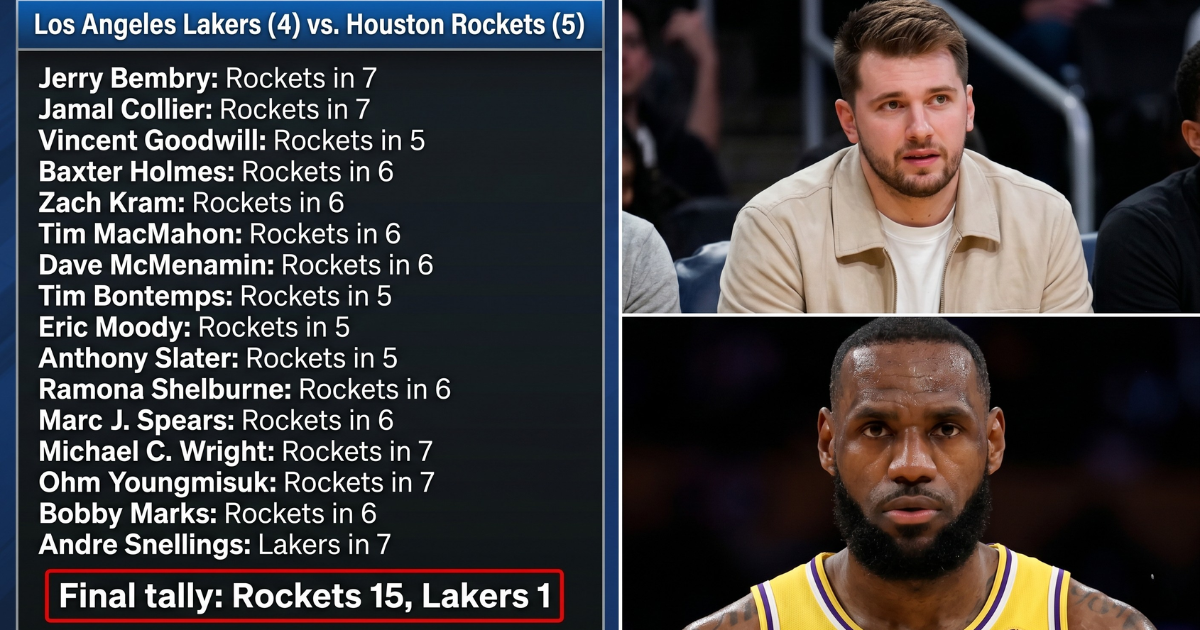
What happened in the 2026 Western Conference first-round series between Los Angeles and Houston? The Los Angeles Lakers secured a commanding 2-0 series lead over the Houston Rockets despite missing their starting backcourt. The Lakers dictated the pace, exploited defensive mismatches, and utilized historic shooting efficiency to dismantle a fully healthy Houston roster.
Key Takeaways & Overview:
Series Status: Lakers lead 2-0.
Key Absences: Luka Doncic and Austin Reaves (Lakers) missed both games with soft tissue injuries. Kevin Durant (Rockets) is out for Game 3 (ankle).
Historic Efficiency: Los Angeles posted a franchise playoff record 68.2% effective field goal percentage in Game 1.
Standout Player: 41-year-old LeBron James recorded 19 points and 13 assists in Game 1, generating 34 points through assists.
Analyst Miss: 15 out of 16 ESPN experts had the Rockets beating the Lakers in the first round prior to the series tipping off.
What happened in the 2026 Lakers vs. Rockets First Round Matchup?
How did the series unfold from start to finish in Games 1 and 2?
The Los Angeles Lakers controlled the tempo and executed a flawless half-court offense to win Games 1 and 2. Entering the series as the 4-seed, Los Angeles played without primary ball-handlers Luka Doncic and Austin Reaves. Houston, the 5-seed, attempted to push the pace and force turnovers. Instead, Los Angeles slowed the game down, minimized transition opportunities, and systematically picked apart Houston's defensive rotations to secure a 107-98 victory in Game 1, followed by a wire-to-wire win in Game 2.
What were the key turning points that defined the first two games?
The series shifted on two distinct statistical anomalies: historic shot-making and unforced errors.
Game 1's historic 107-98 victory and LA's 68.2% eFG%
The Lakers mathematically overwhelmed the Rockets from the perimeter. They recorded a franchise playoff record 68.2% effective field goal percentage (eFG%). This advanced NBA stat adjusts for the fact that three-pointers are worth more than two-pointers. By converting heavily on open corner threes, the Lakers generated an offensive rating that Houston could not match.Kevin Durant's disastrous 9-turnover performance in Game 2
Houston expected an offensive surge when Kevin Durant returned from a knee injury in Game 2. Instead, Durant committed 9 live-ball turnovers. The Lakers utilized aggressive perimeter hedging, forcing Durant to pick up his dribble in traffic. These turnovers directly fueled the Lakers' transition offense and prevented Houston from setting their half-court defense.
Why did this shocking result happen despite massive injuries to the Lakers?
Which offensive strategies made the difference for Los Angeles?
The Lakers won because they prioritized spacing and targeted pick-and-roll mismatches. Without Doncic, they relied on a heliocentric offensive model centered around the high post. They forced Houston's big men into drop coverage, allowing Los Angeles shooters to step into uncontested perimeter jump shots.
How did the Rockets fail to execute their defensive game plan?
Houston failed to adapt their team strategy to counter the Lakers' ball movement. They continually over-helped on drives, leaving weak-side shooters completely unguarded.
LeBron James operating perfectly as the central offensive hub
LeBron James dictated the offensive flow. He operated out of the middle of the floor, forcing Houston to make impossible decisions. If they brought a double-team, James immediately fired cross-court passes to open shooters. If they played him in single coverage, he backed down smaller defenders to score at the rim.Houston's lack of backcourt playmaking and stagnant isolation
The Rockets' offense stalled due to a lack of a traditional point guard. They relied entirely on isolation basketball, which plummeted their overall pace. Without a guard to initiate offense, Houston forwards took contested, low-percentage shots late in the shot clock.
Who were the standout performers and why?
Which Lakers players had the biggest impact on the 2-0 series lead?
Veterans and role players absorbed the usage rate left behind by Doncic and Reaves. They executed their specific roles with high true shooting percentages, punishing Houston's defensive lapses.
Luke Kennard's 27-point Game 1 explosion and LeBron's playmaking
Luke Kennard exploited Houston's drop coverage. He scored 27 points in Game 1, shooting highly efficiently from beyond the arc. Meanwhile, a 41-year-old LeBron James recorded 19 points and 13 assists. His elite court vision generated 34 points via assists, proving that high basketball IQ can neutralize athletic disadvantages.
Who underperformed for the heavily favored Rockets?
Houston's primary scorers failed to generate efficient offense. Their inability to score in the paint allowed the Lakers to lock down the perimeter.
Alperen Sengun's 38.5% shooting slump and poor true shooting
Alperen Sengun struggled against the Lakers' interior length and aggressive fronting in the post. He shot just 38.5% from the floor, resulting in a dismal true shooting percentage. His inability to establish deep post position derailed Houston's inside-out game plan.
What are the strengths and weaknesses revealed in this playoff matchup?
What did the Lakers do well to maximize their depleted roster?
Los Angeles controlled the defensive glass and limited second-chance points. They secured 78% of available defensive rebounds. By ending possessions after one missed shot, the Lakers prevented Houston from utilizing their offensive rebounding strength, forcing the Rockets to play against a set defense every time down the floor.
What glaring issues does the Rockets' system need to fix immediately?
Houston must fix their shot quality and assist generation.
Poor 24th-percentile shot quality on Sengun's assist chances
Advanced game analysis reveals a broken offensive system. When Sengun passed out of the post, those assist opportunities ranked in the 24th percentile for expected shot quality league-wide. The Lakers successfully closed out on shooters, forcing Houston into highly contested attempts.
What does this mean for 2026 NBA Playoff standings and betting odds?
How does this 2-0 lead affect Western Conference advancement?
This series drastically alters the playoff standings and advancement probabilities. By winning two games without their starting backcourt, the Lakers have transferred all pressure onto the Rockets, flipping the mathematical probability of winning the series heavily in their favor.
What are the implications for upcoming games in the series?
The Lakers have successfully bought time.
Buying critical recovery time for Luka Doncic and Austin Reaves
The most valuable asset Los Angeles gained is recovery time. By securing a 2-0 lead, the Lakers can afford to rest Doncic and Reaves, allowing their soft tissue injuries to heal properly before a potential second-round matchup.Sportsbooks inexplicably keeping the Rockets as 8.5-point favorites
Despite the 0-2 deficit, betting markets list Houston as 8.5-point favorites for Game 3. Oddsmakers anticipate severe regression from the Lakers' perimeter shooters on the road, alongside an expected surge from Houston's role players at home.
Why 15 out of 16 ESPN experts were wrong about the LA Lakers in this game and series?
Why did 15 out of 16 ESPN experts have the Rockets beating the Lakers in the first round?
The media consensus relied on the "talent over teamwork" fallacy. Analysts viewed the injuries to Doncic and Reaves as insurmountable, assuming Houston's top-heavy roster would dominate a depleted Lakers squad. This prediction ignored the Lakers' superior half-court execution, high basketball IQ, and elite defensive rebounding.
What does the advanced data actually show about LA's dominance?
The data suggests the Lakers are playing perfectly, but also getting incredibly lucky.
GeniusIQ analytics: Overperforming expected shot probability by +16.7%
Player performance data indicates massive overachievement. According to GeniusIQ tracking, Los Angeles exceeded their expected shot probability by +16.7% in Game 1. Expected shot probability measures the likelihood of a shot going in based on defender distance and location. While this highlights great shot-making, it also signals that a statistical regression to the mean is inevitable.
What happens next for these teams and players?
What tactical adjustments must Houston make to avoid a first-round exit?
Houston must increase their pace and alter their pick-and-roll coverages. They cannot allow James to dissect them from a stationary position. They need to trap the ball handler, force the ball out of James' hands, and make the Lakers' role players initiate the offense off the dribble.
Is the Lakers' historic offensive performance sustainable?
The Lakers face significant sustainability challenges moving forward.
Navigating Kevin Durant's confirmed Game 3 absence
The dynamics shift again for Game 3. Kevin Durant is officially out due to a left ankle sprain. Houston must replace his usage rate, which will likely force Sengun to take on a massive offensive burden as both a scorer and facilitator.Managing LeBron James' heavy workload and 29.5% usage rate
James currently holds a 29.5% playoff usage rate. Usage rate estimates the percentage of team plays used by a player while on the floor. For a 41-year-old, maintaining this level of offensive initiation every 48 hours presents a severe physical risk as the series extends.
Conclusion – What is the deeper takeaway from this series?
What does this reveal about the current NBA landscape?
This series proves that tactical execution, spacing, and processing speed can overcome sheer athletic advantages. The Lakers dismantled a highly touted Houston team by exploiting specific defensive coverages and maximizing their offensive rating through smart shot selection.
What should fans pay attention to moving forward in the playoffs?
Moving forward, observers must monitor the Lakers' shooting efficiency and Houston's pace without Durant. If Los Angeles continues to defy their expected shot probabilities, the fact that 15 out of 16 ESPN experts had the Rockets beating the Lakers in the first round will go down as one of the most glaring analytical misjudgments in recent NBA playoff history.