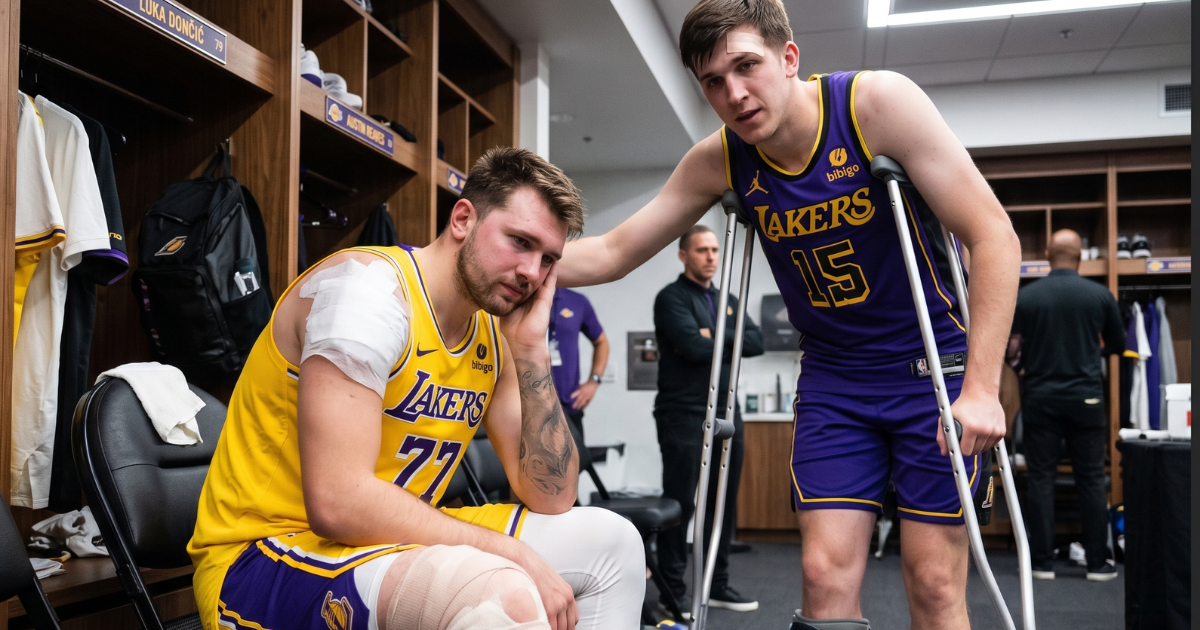
What happened regarding the injuries to Austin Reaves and Luka Doncic?
What happened regarding the injuries to Austin Reaves and Luka Doncic? The Los Angeles Lakers announced that with Austin Reaves closer to returning than Luka Doncic, the team must navigate the 2026 NBA Playoffs without their starting backcourt. Both guards sustained severe muscle strains in early April, forcing immediate tactical adjustments.
This injury timeline significantly alters the Western Conference postseason landscape. The Lakers currently hold a 2-0 first-round series lead over the Houston Rockets despite missing their primary ball-handlers. LeBron James and a retooled supporting cast have absorbed the offensive responsibilities, relying on defensive intensity and half-court execution while waiting for their injured stars to complete rehabilitation.
How did the injury situations unfold from the initial incidents to now?
The crisis began on April 2, 2026, during a regular-season loss to the Oklahoma City Thunder. Both Reaves and Doncic exited the game with non-contact injuries. Initially, the team hoped for minor tweaks, but MRI results confirmed significant muscle damage that sidelined both players for the remainder of the regular season. The Lakers had to immediately pivot their offensive system, leaning heavily on their veteran depth to secure the final playoff standings.
What are the current medical updates and return timelines?
Recent updates from Lakers head coach JJ Redick confirm diverging recovery paths. Reaves has progressed to 1-on-1 on-court basketball activities, putting him on track for a potential return by Game 5 or 6 of the first round. Conversely, Doncic remains out indefinitely. The Slovenian star traveled to Spain for specialized platelet-rich plasma (PRP) and stem cell treatments but has only recently resumed light, non-contact shooting drills.
Specific injury details (severity, grade, and affected areas)
Reaves suffered a Grade 2 left oblique strain, an injury that compromises rotational core strength necessary for shooting and lateral defensive movement. Doncic sustained a Grade 2 left hamstring strain. A Grade 2 strain indicates a partial muscle tear, which severely limits a player's ability to accelerate and decelerate—critical components of Doncic’s step-back jumpers and pick-and-roll navigation.
Missed games and official team press releases
Both players missed the final stretch of the 2025-2026 regular season and the first two games of the opening playoff round. Official press releases from the Lakers medical staff emphasize a cautious approach, explicitly stating that neither player will be rushed back until they pass rigorous biomechanical testing to prevent re-aggravation.
Why did these absences create such different outcomes for LA and Dallas?
Which strategies and tactical shifts made the difference for each team?
When comparing the Lakers' current success without Doncic to the historical struggles of the Dallas Mavericks—Doncic's former team before last year's blockbuster trade—the difference lies in roster construction. Dallas historically relied on a heliocentric model, where Doncic initiated over 80% of half-court sets. When he missed games, the Mavericks' offensive rating plummeted. The Lakers avoided this trap. They built a decentralized offense featuring multiple secondary playmakers, allowing them to absorb the loss of their primary initiator without suffering a complete structural collapse.
How did each coaching staff execute their revised game plan?
JJ Redick implemented a motion-heavy offensive system to compensate for the lack of isolation scoring. Instead of relying on high pick-and-rolls, the Lakers increased their off-ball screening actions.
Offensive efficiency and shot selection without primary playmakers
Without Doncic holding the ball, the Lakers altered their offensive rhythm. To understand this shift, we must look at Pace, which is defined as the number of possessions a team uses per 48 minutes. By increasing their Pace, the Lakers generated early transition opportunities before the Houston defense could set. The biggest factor was shot efficiency. The team converted efficiently from three-point range, performing far above their season average, which created an insurmountable scoring gap early in the game.
Defensive schemes, switchability, and rotation adjustments
Defensively, the absence of Doncic and Reaves forced Los Angeles to rely on point-of-attack stoppers. Marcus Smart stepped into the starting lineup, executing a switch-heavy defensive scheme that neutralized Houston's perimeter threats. This rotational stability prevented the defensive breakdowns that typically occur when a team loses its starting backcourt.
Who are the standout performers stepping up in their absence?
Which players have had the biggest impact filling the void?
At 41 years old, LeBron James continues to defy athletic logic. In Game 2 against Houston, James recorded 28 points, 8 rebounds, and 7 assists. Marcus Smart also delivered a phenomenal two-way performance, registering 25 points, 7 assists, and 5 steals. Luke Kennard provided crucial floor spacing, adding 23 points to keep the offense afloat.
Who underperformed when given expanded opportunities?
While the veterans thrived, some secondary bench pieces struggled with efficiency. Rotational wings who previously relied on Doncic's passing gravity found it difficult to create their own shots against Houston's set defense, resulting in isolated possessions that ended in contested mid-range jumpers.
Key stats, usage rate spikes, and efficiency metrics
The statistical shifts are heavily tied to Usage Rate, which measures the percentage of team plays used by a player while they are on the floor. James saw his Usage Rate spike to 34%, absorbing the offensive load. Despite the high volume, he maintained an elite True Shooting Percentage, highlighting exceptional player performance under pressure.
Decision-making and clutch-time execution without the usual closers
LeBron James controlled the tempo. He dictated offensive flow, created scoring opportunities for teammates, and forced defensive adjustments that opened space across the court. In the fourth quarter of Game 2, James executed a series of high pick-and-rolls that resulted in either layups or open corner threes, effectively closing out the game without Doncic’s traditional clutch-time isolation sets.
What are the strengths and weaknesses revealed by these injuries?
What did the Lakers do well to weather the storm without Reaves?
The Lakers dominated the perimeter. They generated over 40% of their scoring from outside, exposing defensive mismatches and controlling spacing throughout the game. With Reaves sidelined, the team leaned into defensive versatility, deploying lineups that featured five players capable of switching across multiple positions.
What glaring issues do the Mavericks need to fix without Doncic?
Looking at the league-wide impact of Doncic's movement, the Dallas Mavericks failed to replace his offensive production this season, ultimately missing the postseason. The glaring issue for any team losing a player of Doncic's caliber is the immediate drop in shot quality. Without an elite initiator, role players are forced into unfamiliar shot-creation roles.
Bench contribution and secondary unit scoring
For the Lakers, bench contribution became a mathematical necessity. Redick staggered the minutes of James and Smart to ensure that at least one elite passer remained on the floor at all times, preventing the secondary unit from stalling out in the half-court.
Turnovers, perimeter defense, and late-game shot selection
A notable weakness for Los Angeles has been live-ball turnovers. Without Reaves’ steady ball security, the Lakers occasionally struggled against Houston's full-court pressure, leading to transition points for the opposition. However, their perimeter defense compensated for these mistakes.
What does this mean for the standings and Western Conference playoffs?
How do these contrasting return timelines affect rankings and seeding?
The injuries occurred late in the regular season, dropping the Lakers into a lower seed than anticipated. However, securing a 50-27 record kept them out of the Play-In Tournament. Because Austin Reaves is closer to returning than Luka Doncic, the Lakers can realistically project a bolstered roster for a potential second-round matchup, provided they close out the Rockets.
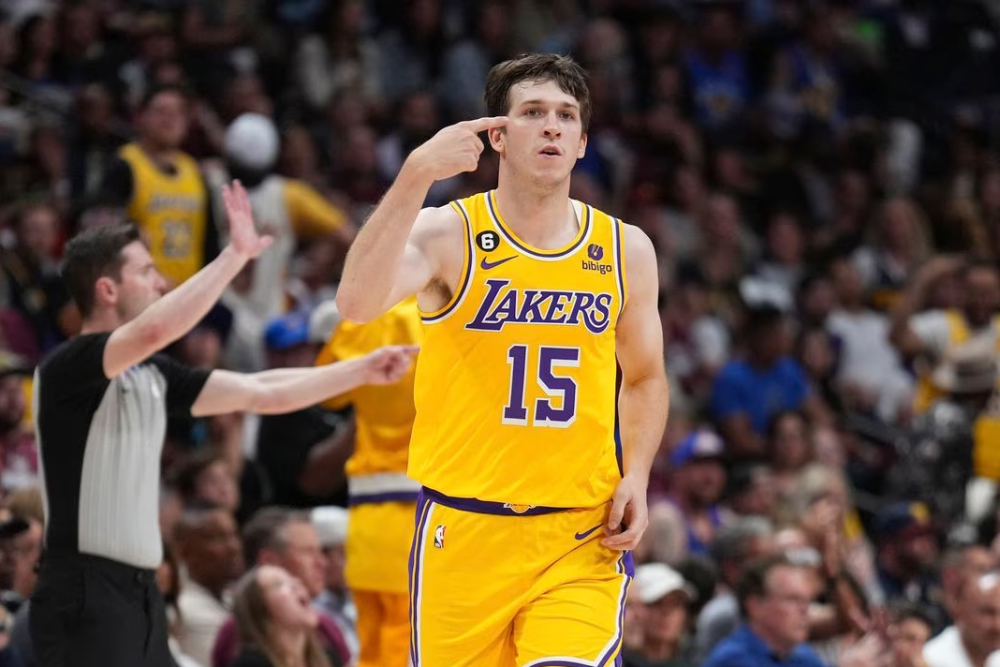
What are the implications for upcoming critical games?
The series shifts to Houston for Games 3 and 4. Winning on the road without two starters requires flawless execution. If the Lakers drop both games, the pressure to rush Reaves back ahead of Game 5 will intensify dramatically.
H4: Strength of schedule for the Lakers and Mavericks
The playoff schedule provided Los Angeles with a distinct advantage. With two full days of rest between Games 1 and 2, and similar gaps between subsequent matchups, the Lakers' older roster receives adequate recovery time while Reaves maximizes his rehabilitation window.
Key matchups ahead and tiebreaker scenarios
If the Lakers advance, they will face top-tier Western Conference opponents possessing elite guard play. Surviving against those teams without Doncic will require Marcus Smart to maintain his current, highly elevated level of two-way production.
Misconceptions About Austin Reaves Closer To Returning Than Luka Doncic
What narratives surrounding Luka's absence are misleading or exaggerated?
A growing narrative suggests the Lakers play better team basketball without Doncic because the ball moves more freely. This is mathematically false. While the aesthetic of motion offense is appealing, the data proves that replacing elite isolation efficiency with average spot-up shooting yields a lower overall points-per-possession metric.
What does the data actually show about the Lakers without Reaves?
Without Reaves, the Lakers lack secondary rim pressure. Fans often view Reaves purely as a shooter, but his ability to draw fouls and manipulate drop coverage in the pick-and-roll is statistically irreplaceable for this roster.
Advanced stats vs. surface-level stats (On/Off court splits)
To grasp this, we evaluate Offensive Rating, defined as the number of points a team produces per 100 possessions. The Lakers’ Offensive Rating drops by 6.4 points when Reaves and Doncic are off the floor. Surface-level stats like team assists may rise, but advanced metrics indicate a steep decline in overall shot quality.
Context behind viral moments or misleading win-loss streaks
While LeBron’s reverse windmill dunk in Game 2 generated viral highlights, it masks the reality that the Lakers are operating with a razor-thin margin for error. Winning two home games against a lower-seeded Houston team missing a fully healthy Kevin Durant does not equate to sustainable championship contention without their star backcourt.
With Austin Reaves Closer To Returning Than Luka Doncic, What Happens Next?
What rotation adjustments should be made upon their return?
When Reaves returns, JJ Redick must cautiously integrate him into a rotation that has found a temporary rhythm. Reaves will likely come off the bench initially to manage his workload, replacing the backup guard minutes while allowing Marcus Smart to continue starting until Doncic is cleared.
Is the current level of play from role players sustainable?
Shooting variance suggests that Marcus Smart will not consistently hit five three-pointers per game. If his perimeter efficiency regresses to his career averages, the Lakers will struggle to score enough points to support James's heavy usage.
Injury considerations, minute restrictions, and conditioning
Soft tissue injuries have high recurrence rates. The medical staff will likely implement strict minute restrictions for Reaves, capping him at 20-24 minutes per game upon his initial return. Conditioning will also be a factor, as oblique strains prevent players from maintaining heavy cardiovascular conditioning during rehab.
Tactical evolution and reintegrating high-usage players
Reintegrating Doncic will require a secondary tactical shift. The team will need to blend their newly discovered ball-movement principles with Doncic’s isolation dominance, creating a hybrid system that maximizes both team strategy and individual player performance.
Conclusion – What is the deeper takeaway from this injury timeline?
What does this reveal about star dependency vs. depth in the current NBA landscape?
The fact that the Los Angeles Lakers are surviving the simultaneous loss of Luka Doncic and Austin Reaves underscores the vital importance of roster depth in the modern NBA. While star power raises a team's ceiling, veteran depth and defensive versatility establish the floor necessary to survive the grueling attrition of the playoffs.
What should fans pay attention to moving forward?
Moving forward, observers must monitor Reaves’ progression through 3-on-3 and 5-on-5 contact drills. His successful return will dictate whether the Lakers can maintain their championship aspirations or if the physical toll on LeBron James will ultimately derail their postseason run. Until Doncic provides a concrete timeline, Los Angeles remains a dangerous, yet highly vulnerable, playoff contender.