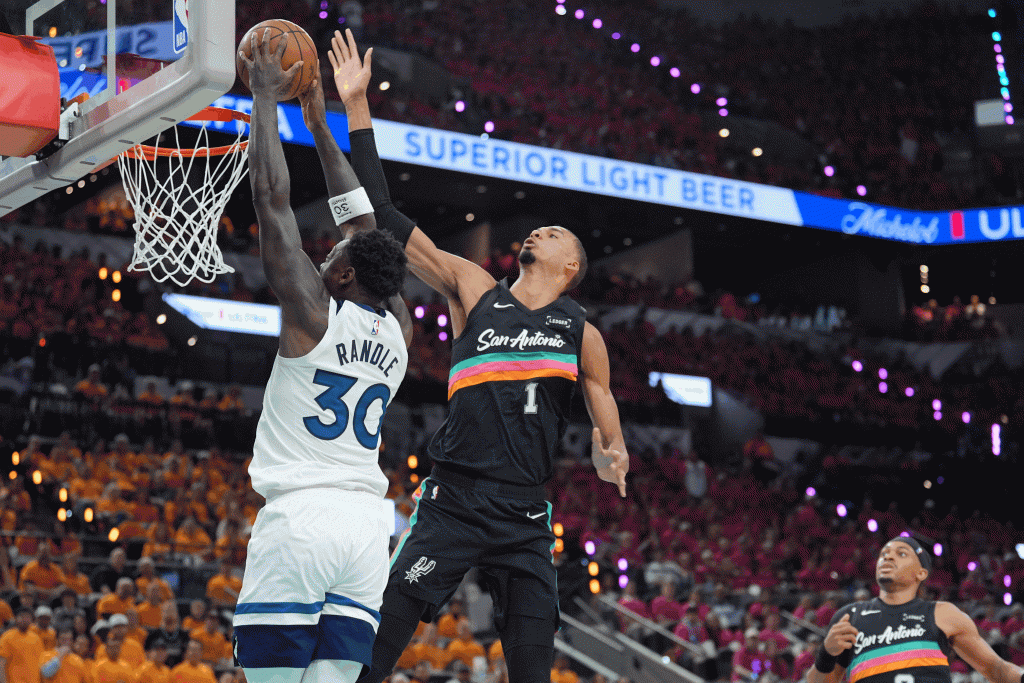
What happened in Victor Wembanyama’s record-breaking playoff game?
Victor Wembanyama set a new NBA playoff record by recording 12 blocks in Game 1 of the Western Conference Semifinals on May 4, 2026. Despite this historic defensive performance, the San Antonio Spurs suffered a 104-102 loss to the Minnesota Timberwolves. The game established a new historical precedent as Wembanyama surpassed the previous record of 10 blocks held by Hakeem Olajuwon, Mark Eaton, and Andrew Bynum.
While Wembanyama’s individual player performance was legendary, the Spurs' inability to secure the perimeter led to their downfall. Minnesota utilized a balanced scoring attack and a late-game tactical shift to overcome the most dominant individual defensive display in playoff history.
This victory gives the Timberwolves a 1-0 lead in the series and significantly shifts the playoff standings outlook for the Western Conference.
How did the record-breaking game unfold for the Spurs and Timberwolves?
What were the key moments in Wembanyama’s record-breaking run?
The game was defined by a steady escalation of defensive dominance. Wembanyama recorded four blocks in the first quarter alone, signaling a primary intent to protect the rim against Minnesota’s aggressive drivers. By halftime, he had already reached seven blocks, matching his previous career playoff high.
The Record-Breaking Moment: With 8:26 remaining in the fourth quarter, Wembanyama swatted a layup attempt to reach 11 blocks, officially surpassing the all-time record.
The Final Milestone: He added a 12th block on a Terrance Shannon Jr. drive at the 4:46 mark, effectively erasing nearly 15% of Minnesota’s attempted shots at the rim.
What were the critical momentum shifts?
The game turned on the Spurs' inability to convert defensive stops into transition points. Although Wembanyama stifled the Timberwolves' interior offense, the Spurs committed 14 turnovers, which allowed Minnesota to maintain a steady pace and prevent San Antonio from building a significant lead. A late 8-0 run by Minnesota in the final three minutes neutralized the energy from Wembanyama’s record-setting 12th block.

Why did the San Antonio Spurs lose despite 12 blocks?
Which tactical decisions favored the Timberwolves?
The Timberwolves won because they recalibrated their shot profile in the second half. After seeing 12 shots rejected, Minnesota’s coaching staff instructed players to utilize the "short roll" and mid-range floaters rather than attacking the restricted area directly. This adjustment lowered their rim frequency but increased their Effective Field Goal Percentage (eFG%) by avoiding Wembanyama’s reach.
How did perimeter shooting impact the result?
The Spurs' 28% shooting from three-point range (10-for-36) was the primary statistical driver of the loss. In modern NBA stats, it is nearly impossible to win a playoff game when the opponent outshoots you by 10% from beyond the arc. Minnesota’s 38% clip from deep provided a math advantage that Wembanyama’s blocks could not overcome.
Who were the standout performers in Game 1?
How did Victor Wembanyama’s triple-double compare to historical peers?
Wembanyama finished with 11 points, 15 rebounds, 10 assists, and 12 blocks. At 22 years and 120 days old, he is the youngest player to record a triple-double with blocks in postseason history. His 12 blocks accounted for a staggering Block Percentage that likely exceeded 25% during his 39:52 minutes on the floor.
Which Minnesota players countered the Wembanyama effect?
Julius Randle and Dylan Harper were instrumental in the Timberwolves' victory. Randle’s 21 points were largely earned through physical post-ups and mid-range jumpers that forced Wembanyama to defend further from the hoop. Anthony Edwards, returning from injury, provided 18 points and secondary playmaking that stressed the Spurs' perimeter rotations.
Player
PTS
REB
AST
BLK
Efficiency Note
V. Wembanyama
11
15
10
12
Record 12 Blocks
J. Randle
21
10
3
0
8/20 FG
D. Harper
18
4
5
0
High-impact rookie
A. Edwards
18
5
4
1
Return from injury
What strengths and weaknesses were exposed?
What is the biggest concern for the Spurs moving forward?
The Spurs' primary weakness is their over-reliance on Wembanyama to fix defensive breakdowns. While he can deter shots at the rim, he cannot defend the three-point line and the paint simultaneously. San Antonio’s guards allowed too many "blow-by" drives, which forced Wembanyama into help-defense positions and left Minnesota’s shooters open for kick-out threes.
How did the Timberwolves exploit the Spurs' backcourt?
Minnesota targeted De’Aaron Fox, who struggled with a 6-point, 6-turnover performance. By applying full-court pressure and utilizing physical defenders, the Timberwolves disrupted the Spurs' offensive rating and forced Wembanyama to create his own shots—a task that proved difficult as he focused his energy on the defensive record.
What are the common misconceptions about this record-breaking game?
Does a high block count always equate to elite defense?
Not necessarily. While 12 blocks is a historical anomaly, the game analysis shows that 5 of those blocks went out of bounds, allowing Minnesota to retain possession. A "soft" block that stays in play is statistically more valuable than a "hard" block that resets the shot clock. Fans often overlook that Minnesota still scored 104 points, suggesting the Spurs' overall defensive scheme had significant leaks.
Was Wembanyama's offensive performance a disappointment?
Critics may point to his 11 points as a low output. However, his 10 assists suggest he was acting as a primary hub for the offense. His Usage Rate was high, but his teammates' inability to convert open looks (28% 3PT) deflated his scoring impact and overall offensive efficiency.
What happens next in the Spurs vs. Timberwolves series?
What adjustments will the Spurs make for Game 2?
The Spurs must prioritize perimeter containment. If they can limit Minnesota’s 3PT attempts, Wembanyama’s rim protection becomes a much more lethal weapon. Additionally, expect the Spurs to run more high-screen actions to get Wembanyama moving toward the rim offensively, rather than settling for perimeter touches.
Is Victor Wembanyama 12 blocks playoff record ceiling sustainable?
A 12-block performance is statistically unlikely to be repeated in the same series. However, his Defensive Gravity remains the most important factor in the matchup. Even if he only records 3 or 4 blocks in Game 2, the threat of the block will continue to dictate Minnesota’s shot selection and offensive flow.
Conclusion: The Deeper Takeaway for the NBA
This game proves that while individual records are spectacular, team strategy and shooting efficiency remain the ultimate arbiters of playoff success. Victor Wembanyama has officially moved past Hakeem Olajuwon and Andrew Bynum in the record books, but he now faces the challenge of translating defensive dominance into series wins.
For fans and bettors, the key takeaway is the "Math Problem." If the Spurs cannot shoot better than 30% from deep, even a 15-block game from Wembanyama might not be enough to overcome the Timberwolves' depth. Keep a close eye on the playoff standings and the Game 2 shooting splits to see if San Antonio can provide their superstar with the necessary support.