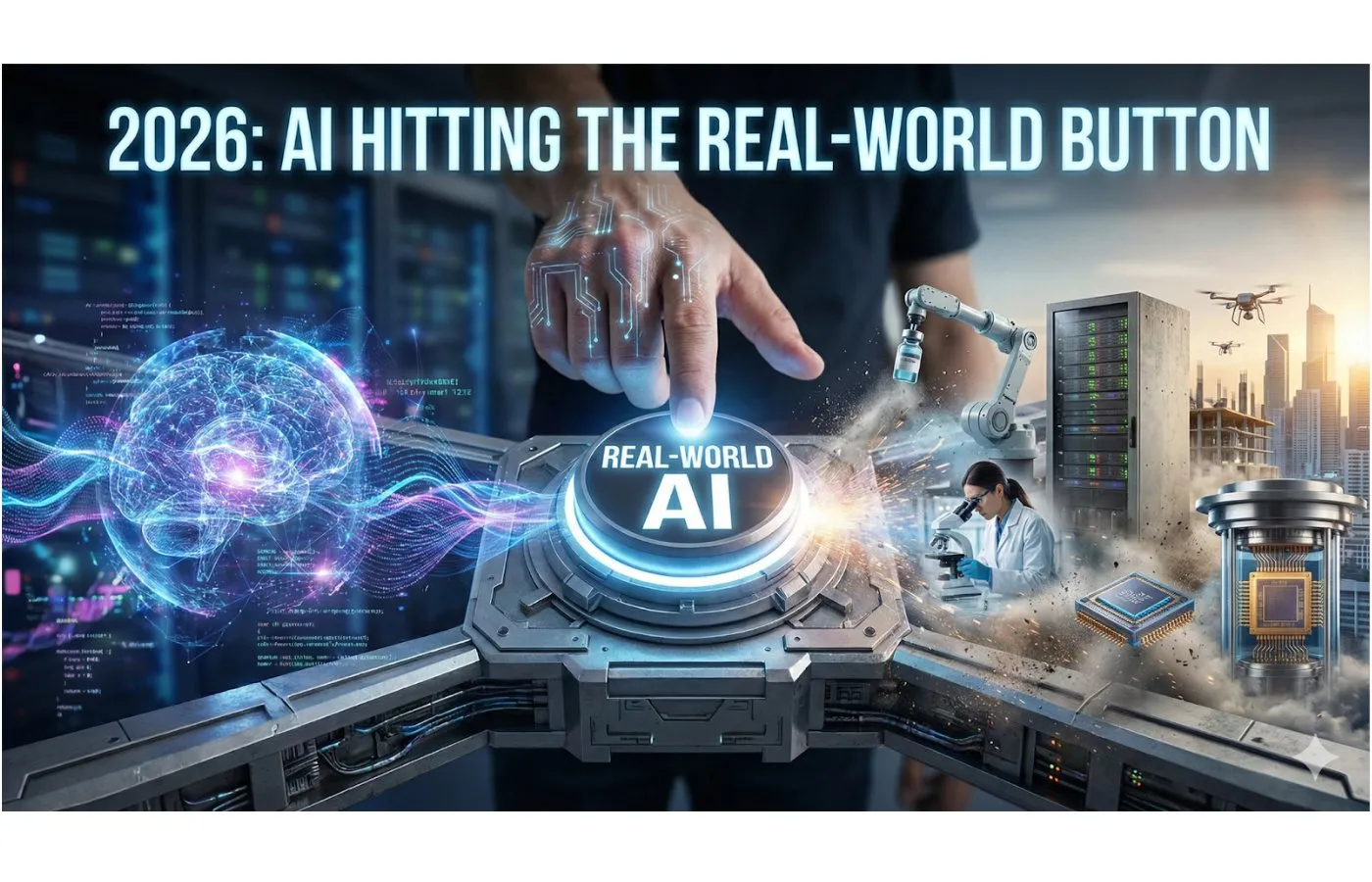
Introduction: AI Enters Its Most Practical Era Yet
Artificial intelligence has spent the last decade captivating the tech world with bold promises, breakthrough models, and massive investments. But in 2026, the narrative is shifting. According to recent coverage from TechCrunch, AI is no longer just about scale, hype, or futuristic demos—it’s about real-world usability, efficiency, and measurable impact.
After years dominated by increasingly large language models and headline-grabbing innovations, the industry is entering a new phase. This phase prioritizes integration into everyday workflows, cost optimization, and tangible business outcomes. From startups raising billions to enterprises restructuring their workforce strategies, AI in 2026 is becoming deeply embedded in how industries operate.
The Shift From Hype to Pragmatism
In previous years, the AI race was defined by scale—bigger models, more data, and higher computational power. But experts now believe that approach is reaching its limits. Instead, 2026 is expected to be a turning point where practicality takes center stage.
Rather than building massive, generalized systems, companies are focusing on smaller, specialized models that are faster, cheaper, and more efficient. These models can be fine-tuned for specific business use cases, making them more appealing for enterprises that want reliable results without enormous infrastructure costs.
This transition reflects a broader maturity in the AI ecosystem. Businesses are no longer asking, “What can AI do?” but rather, “How can AI solve this specific problem?”
At the same time, new architectures and approaches are emerging to overcome the plateau in traditional scaling methods. Researchers and companies alike are exploring alternatives that emphasize reasoning, adaptability, and real-world interaction over brute computational force.
AI Startups Are Raising Record-Breaking Funding
Despite the shift toward practicality, investor enthusiasm for AI remains stronger than ever. In just the first months of 2026, nearly 20 U.S.-based AI startups have already raised funding rounds exceeding $100 million.
This surge builds on an already massive 2025, where AI startups collectively secured over $76 billion in mega-rounds. The momentum shows no signs of slowing down, with several companies achieving multi-billion-dollar valuations early in the year.
Notable trends in AI startup funding include:
-
Increased investment in generative AI platforms
-
Growth of AI infrastructure and tooling companies
-
Rising interest in AI-powered decision-making systems
-
Expansion of AI into niche industries like healthcare, climate tech, and finance
One key takeaway is that investors are no longer just betting on potential—they’re backing companies that demonstrate clear paths to revenue and scalability.
The Rise of AI Agents and Autonomous Systems
One of the most transformative developments in 2026 is the rise of AI agents—systems capable of performing tasks autonomously with minimal human intervention. These agents go beyond chatbots, acting as digital workers that can plan, execute, and adapt.
A notable example is Manus, an advanced AI agent capable of handling complex workflows such as coding, research, and task automation. Its development signals a broader industry shift toward systems that can operate independently rather than simply assist users.
AI agents are expected to play a major role in:
-
Automating repetitive business processes
-
Enhancing productivity in knowledge work
-
Powering customer service and operations
-
Supporting software development and IT management
Experts predict that 2026 could be “the year of agents,” where AI transitions from a supportive tool to an active participant in workflows.

Physical AI: From Software to Real-World Devices
Another major trend is the emergence of “physical AI”—the integration of artificial intelligence into hardware and real-world environments. This includes robotics, autonomous vehicles, wearables, and smart devices.
Unlike traditional software-based AI, physical AI interacts directly with the environment. This opens up new possibilities, such as:
-
Smart glasses that provide real-time context
-
AI-powered health monitoring devices
-
Autonomous delivery systems and drones
-
Robotics in manufacturing and logistics
Wearables, in particular, are becoming a key entry point for consumers. Devices that combine sensors, connectivity, and AI inference are making always-on intelligence a reality.
This shift represents a major expansion of AI’s reach—from digital interfaces into the physical world.
Enterprise Adoption and the Future of Work
As AI becomes more practical, enterprises are rapidly integrating it into their operations. But this transformation comes with significant implications for the workforce.
Studies suggest that a growing percentage of jobs can already be partially automated using AI technologies. Companies are beginning to rethink how they allocate resources, often shifting budgets from labor to AI systems.
This doesn’t necessarily mean widespread job loss—but it does signal a major change in how work is structured. AI is increasingly being used to:
-
Automate repetitive tasks
-
Enhance decision-making processes
-
Improve operational efficiency
-
Enable employees to focus on higher-value work
However, concerns about job displacement remain. Many experts believe 2026 will be a defining year in understanding how AI impacts employment at scale.

Ethical Challenges and AI Controversies
With rapid adoption comes increased scrutiny. AI technologies continue to raise ethical questions around privacy, bias, and misuse.
One of the most controversial developments involves the misuse of generative AI for creating harmful or misleading content. Incidents involving deepfake technology have sparked global debate and regulatory attention.
Key ethical challenges include:
-
Ensuring transparency in AI decision-making
-
Preventing misuse of generative tools
-
Protecting user privacy in always-on systems
-
Establishing clear governance frameworks
As AI becomes more powerful and widespread, addressing these issues will be critical for maintaining public trust.
Global Competition and AI Innovation
AI is also becoming a central battleground for global technological leadership. Companies and governments around the world are investing heavily in research, infrastructure, and talent.
Organizations like Anthropic are pushing the boundaries of AI capabilities, including applications in national security and advanced research. Meanwhile, international players such as Z.ai are expanding globally with new models and applications.
This competition is driving rapid innovation but also raising geopolitical concerns. Issues such as data sovereignty, export controls, and national security are becoming increasingly important in the AI landscape.

The Future: What Comes Next for AI?
Looking ahead, several key themes are expected to define the future of artificial intelligence:
1. Smaller, Smarter Models
Efficiency will become more important than size, with companies prioritizing performance and cost-effectiveness.
2. AI as Infrastructure
AI will become a foundational layer in software systems, much like cloud computing is today.
3. Human-AI Collaboration
Rather than replacing humans, AI will increasingly augment human capabilities.
4. Regulation and Governance
Governments and organizations will introduce frameworks to manage risks and ensure responsible use.
5. Expansion Into Everyday Life
From homes to workplaces, AI will become an invisible but essential part of daily routines.
Conclusion: AI’s Real Moment Has Arrived
Artificial intelligence is no longer just a futuristic concept—it’s a practical tool reshaping industries, economies, and everyday life. In 2026, the focus has shifted from what AI could do to what it actually does.
With record-breaking startup funding, the rise of autonomous agents, and increasing enterprise adoption, AI is entering a new era of maturity. At the same time, challenges around ethics, employment, and regulation highlight the need for careful oversight.
As the industry continues to evolve, one thing is clear: AI is not slowing down. Instead, it’s becoming more integrated, more impactful, and more essential than ever before.